
Overview

Role
Lead Product Designer
Scope
End-to-end product strategy
UI Design
UX Research
UX Design
Supported Clinical Systems
EMIS Web, SystemOne, Vision, Medicus
ScriptSwitch Prescribing is the UK’s leading prescribing decision support software. It operates across primary care in England, Scotland, and Wales, covering over 31 million patients across 5,000+ GP practices and 130+ Integrated Care Systems (ICSs) and Health Boards.
The platform generates over £11M in annual revenue while delivering over £62M in annual net savings to the NHS through safer, cost-effective prescribing decision support at the point of care.

The Problem
General practitioners in the NHS operate under intense time pressure, often with less than ten minutes per patient consultation. ScriptSwitch was designed to prompt prescribers with safer, more cost-effective medication alternatives, but the legacy interface suffered from severe alert fatigue. Intrusive popups, walls of dense clinical text, and cluttered formatting disrupted doctor-patient consultations. Clinicians routinely closed alerts without reading them, missing vital safety updates and costing healthcare trusts millions in lost prescribing efficiencies.
The Solution
We redesigned the prescribing decision support interface from the ground up to respect the consultation flow. Replacing dense text blocks with an intuitive side-by-side layout allows GPs to immediately evaluate the original medication against suggested alternatives, dosing differences, and financial savings. Clear single-click actions and concise clinical rationale reduced cognitive friction, helping prescribers make safe, cost-effective decisions in seconds without derailing patient care.
User Research & Field Discovery
To ground the redesign in genuine clinical workflows, an extensive qualitative and quantitative field research initiative was conducted across NHS surgeries and Health Boards in England, Scotland, and Wales.


Clinician Autonomy & Button Bias
Early testing showed that making "Accept Replacement" visually dominant while muting "Continue with Original" alienated GPs. Clinicians perceived the software as prioritizing financial savings over patient safety.
Price Transparency Builds Trust
Removing absolute drug prices in favor of a single net savings figure backfired. Prescribers noted that seeing the original price versus the replacement price was essential for evaluating value and explaining changes to patients
Publishing Risk in Content Manager
MMTs lacked a way to test how authored text, formatting, and placeholders would look on a GP's screen before deployment, leading to truncated messages and formatting errors at point of care
Designing the Experience
The Pop-Up modal was re-engineered to maximize legibility, eliminate button bias, and deliver targeted clinical reasoning without adding consultation time.

Unbiasing the Primary Action Buttons
Problem: In early prototypes, Accept Replacement was styled as a primary action button while Continue with Original was secondary. Prescribers felt nudged into accepting switches.
Solution: Both buttons were given equal visual hierarchy, neutral styling, and placement.
Validation: 100% (6/6) of tested GPs immediately noticed Continue with Original, and prescribers reported higher confidence in exercising clinical overrides when appropriate.

Restoring Full Price Transparency
Problem: Showing only a "Cost Benefit" figure reduced trust. Prescribers stated: "People don't believe a figure just saying cost benefit...you want to see the underlying price."
Solution: Re-introduced explicit Est. Cost labels above both the original prescribed drug and the proposed replacement, alongside the calculated

Targeted Switch Content
Problem: Generic switch recommendations appeared for patients regardless of their underlying clinical status, leading to alert fatigue or unsafe recommendations for high-risk patient cohorts
Solution: Integrated real-time diagnosis history to trigger patient-specific recommendations, displaying a dedicated 'Targeted Switch' badge so prescribers immediately recognize the clinical-code rationale.
To move beyond financial switches and actively prevent hospital admissions, ScriptSwitch integrated the national PINCER and PINCER+ clinical indicators.


Targeted Switch Content
Patient Record Trigger
When a clinician opens a patient's chart, ScriptSwitch queries encrypted local data against 13+ PINCER indicators.
Categorized Severity:
Red, Amber or Blue depending on severity
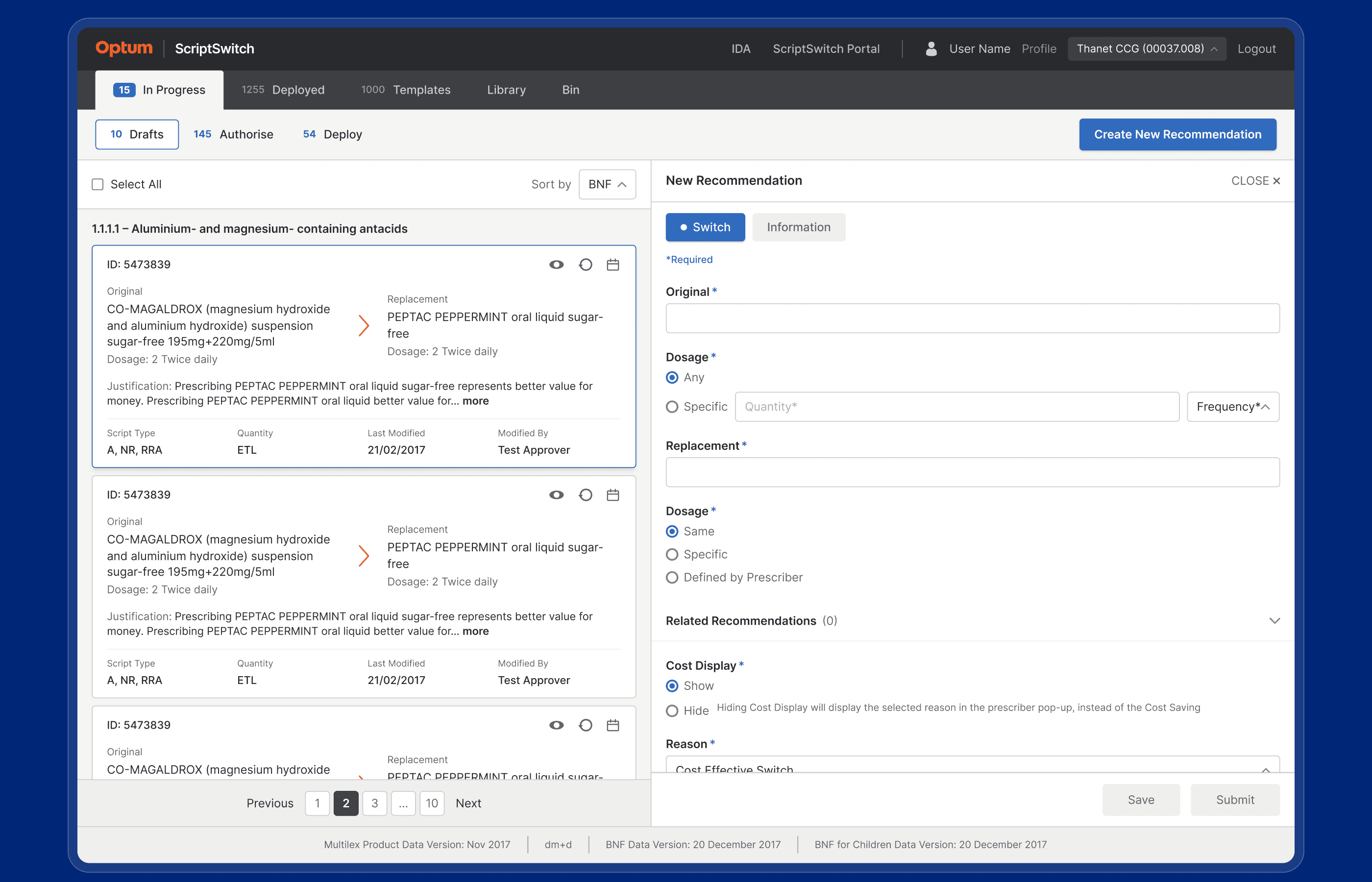
While the Pop-Up manages point-of-care decisions, Content Manager 3 (CM3) provides the enterprise web portal where pharmacists build and deploy rules.

Real-Time Pop-Up Previewer
Integrated an inline rendering modal that allows MMTs to preview exactly how justification text, formatting, hyperlinks, and replacement options will look on a GP's screen before publishing.
Clash Resolver Engine
Removing absolute drug prices in favor of a single net savings figure backfired. Prescribers noted that seeing the original price versus the replacement price was essential for evaluating value and explaining changes to patients.
Selective Rule Suspension
Allows MMTs to temporarily suspend rules during national drug shortages without deleting historical clinical justifications.
Outcome
31M+
Patients Covered
Deployed across 31+ million patients and 5,000+ GP practices, covering 100% of Scotland and Wales and >41% of England.
£62M+
Direct NHS Cost Reduction
Delivered over £62 million in annual prescribing cost savings back to the NHS
41%
avg
Acceptance Rate
Typically ranging between 20% and 52% across different NHS boards in the UK